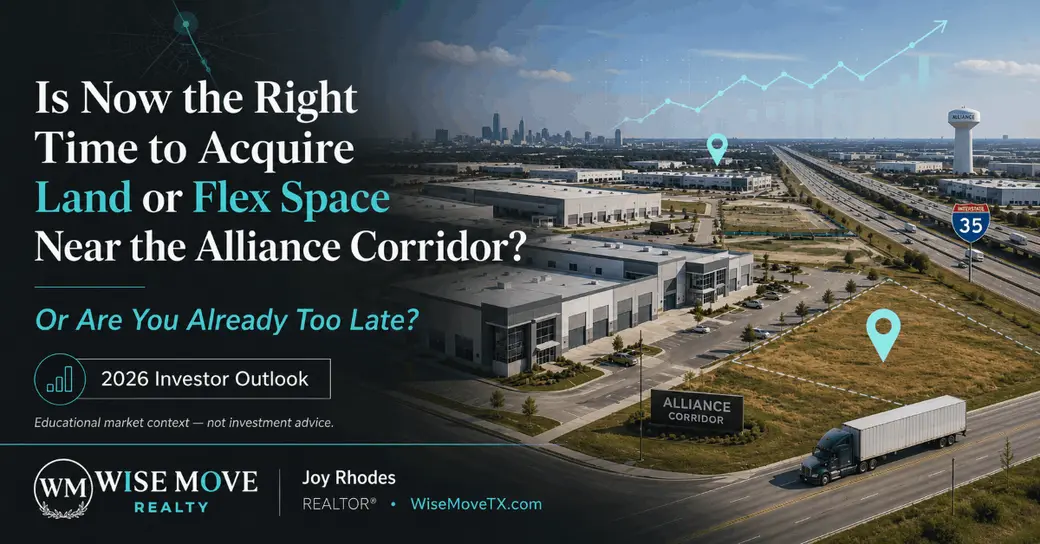
Is Now the Right Time to Acquire Land or Flex Space Near the Alliance Corridor — or Are You Already Too Late?
Quick Answer: The Alliance corridor industrial market is supported by genuine occupier demand, sustained job growth, and the largest speculative industrial pipeline in AllianceTexas history. Acquisition opportunities exist, particularly in small-bay flex and corridor-adjacent markets. Whether a specific acquisition underwrites to your required return depends on your basis, product type, and hold strategy — not on the macro story alone. This article is market context, not investment advice.
If I'm being honest, the window near the Alliance corridor isn't closed — but it's not wide open either. The question isn't whether this market is strong. It is. The question is whether you're acquiring at a point where the risk-adjusted return still makes sense for your specific situation, or whether you're buying the back half of a run that already happened.
Here's what the data says. What it means for your portfolio is a conversation for your financial and legal advisors.
What's Happening at AllianceTexas Right Now
The numbers are not subtle. According to Community Impact reporting on Hillwood's February 2026 presentation to Fort Worth City Council, total investment in AllianceTexas reached $18.3 billion in 2025, with the development hosting 602 companies and supporting more than 73,000 jobs. The Dallas-Fort Worth area led the country in industrial real estate under construction at the start of 2026, with 28.8 million square feet actively in development per CommercialSearch — and the Alliance submarket is the single largest contributor to that pipeline.
In April 2026, Hillwood announced two new speculative buildings — Alliance Gateway 70 at 268,623 square feet and Alliance Gateway 71 at 501,235 square feet — pushing their total speculative industrial portfolio to five buildings under construction, per Hillwood's press release and Fort Worth Report coverage. These figures reflect conditions at time of writing. Verify current pipeline status directly with Hillwood or a commercial broker before drawing acquisition conclusions.
Reality Check: Hillwood builds Class A logistics and industrial at scale. Their pipeline activity signals sustained tenant demand — relevant context for every investor in the corridor. But their product is not your competition. Small-bay flex space under 50,000 square feet, infill industrial, and land plays adjacent to the established AllianceTexas footprint are a different category with different dynamics and different underwriting requirements.
What the Industrial Rent Picture Looks Like
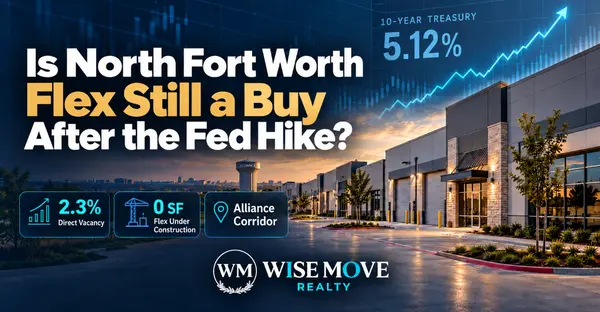
Based on market commentary from commercial sources active in the corridor as of early-to-mid 2026, smaller infill spaces under 50,000 square feet in the DFW market have been cited in the $10 to $12.50 per square foot NNN range, with new suburban product in high-demand Alliance-area corridors ranging higher. These figures are directional reference points — verify current in-place rents and asking rents through a licensed commercial broker or CoStar data before underwriting any specific acquisition. Rent ranges move as pipeline is absorbed and as market conditions shift.
The analyst consensus as of mid-2026 suggests that as construction slows and existing pipeline is absorbed, rent growth could resume a more upward trajectory. That framing reflects market observer opinion, not a guaranteed outcome. Underwrite to current verified rents, not to projected growth.
Pro Tip: The Alliance corridor isn't a single market. North Richland Hills, Haslet, Roanoke, and Decatur each have distinct supply dynamics, infrastructure access, and tenant profiles. A flex acquisition in North Richland Hills is a different underwriting exercise than a land play near Decatur's Eagles Landing business park. Confirm which submarket's dynamics actually apply to your target property before drawing on corridor-wide data.
The Decatur Play: Lower-Cost Entry With Real Logistics Access
Decatur doesn't get mentioned in the same breath as Alliance, but it warrants analysis for investors who want access to the I-35 corridor without the pricing premium of the core AllianceTexas footprint.
The Eagles Landing Business Park in Decatur sits on 535 acres with highway access connecting to Fort Worth Alliance Airport and the I-35 corridor, per the Decatur Economic Development Corporation. The infrastructure is in place. The tenant profile skews toward advanced manufacturing, distribution, and equipment dealers rather than large-format logistics users.
For an investor evaluating lower land cost, meaningful regional logistics connectivity, and a less crowded competitive landscape, Decatur is worth analysis as a complementary market with a different risk profile — not as an Alliance alternative, but as a distinct investment thesis that requires its own underwriting.
Local Note: Decatur has been the economic center of Wise County since 1857. The growth story here is measured and long-running, which is what makes it a different kind of investment case than the Alliance corridor proper.
The Honest Answer on Timing
Land immediately adjacent to the established AllianceTexas footprint was more attractively priced three to five years ago. That pricing has moved. Whether current pricing still underwrites to your required return is a function of your specific basis, financing structure, hold period, and exit assumptions — not a function of whether the macro story is compelling.
Corridor-adjacent markets including Haslet, Roanoke, Decatur, and sections of North Richland Hills may still present acquisition opportunities that haven't been fully priced to the larger macro narrative. Whether any specific opportunity makes sense requires verified current rents, a current appraisal or broker opinion of value, and analysis from your commercial broker and financial advisors — not a blog article.
What Most Investors Miss: The Opportunity Zone program was made permanent by the OBBBA and restructured with rolling ten-year designations, per IRS guidance. If you have capital gains to deploy, QOZ investments in qualifying areas may offer tax deferral benefits worth exploring with your tax advisor. The specific zones and effective dates require verification through IRS.gov or your CPA — do not act on this provision without professional guidance.
FAQs
What types of commercial property make sense for investors near the Alliance corridor in 2026?
Small-bay flex space under 50,000 square feet, infill industrial, and corridor-adjacent land are the categories where mid-size private investors can compete most effectively against institutional capital. Whether any specific property type makes sense for your portfolio depends on your investment objectives, risk tolerance, and hold strategy — consult a licensed commercial real estate broker and your financial advisors.
What NNN rents should I underwrite for flex space near the Alliance corridor in 2026?
Market commentary from commercial sources active in this corridor cites small infill spaces in the $10 to $12.50 per square foot NNN range, with new suburban product running higher. These are directional figures only. Verify current in-place rents and recent lease comparables through a licensed commercial broker or CoStar before finalizing any underwriting.
How does Decatur compare to Alliance as an investment market?
Decatur offers lower land cost, I-35 corridor access, and a less competitive acquisition environment. The trade-off is a smaller tenant pool and slower-growth market dynamic. Whether that trade-off makes sense for your portfolio is an underwriting question specific to your return requirements and hold period.
What did the One Big Beautiful Bill Act change for commercial real estate investors?
Key provisions reported by NAR and major tax law firms include: the 20% QBI deduction made permanent, 100% bonus depreciation reinstated on qualifying property, and the Opportunity Zone program made permanent with restructured designations. Business property taxes on Schedule E remain fully deductible as a business expense and are not subject to the SALT cap. Confirm how these provisions apply to your specific entity structure and tax situation with a licensed CPA.
Is there a commercial real estate bubble forming near the Alliance corridor?
The majority of large-format buildings being delivered by Hillwood are reportedly pre-leased or built-to-suit, reflecting occupier demand rather than speculative overbuilding, per available market reporting. The risk of oversupply exists in specific size ranges and submarkets if job growth slows. The more relevant risk for private investors is acquiring at a basis that only underwrites at continued rent growth rates. Conservative underwriting is appropriate.
A note on this content: This article is educational and informational only. It does not constitute legal, tax, financial, or investment advice. Market data, rent figures, and pipeline information cited reflect sources available at time of writing and may have changed. All investment decisions should be made in consultation with a licensed commercial real estate broker, financial advisor, and CPA who can evaluate your specific situation. Past market performance does not guarantee future results.
Ready to talk through your next move? Schedule a conversation at WisemoveTX.com.
Joy Rhodes | REALTOR® WisemoveTX.com joy@wisemovetx.com TX License #0622809
Categories
- All Blogs (65)
- Commercial / Investors (20)
- Equity & Investment Strategy (5)
- Family & Community (6)
- Food & Dining (3)
- Market Insights (25)
- Neighborhood Spotlights (11)
- North Fort Worth Growth & Development (6)
- North Texas Living (15)
- Outdoor Life & Recreation (4)
- Residential Buyers (27)
- Residential Sellers (24)
Recent Posts