The Real Cost of Waiting to Buy a Home in Keller, Haslet, or North Richland Hills in 2026
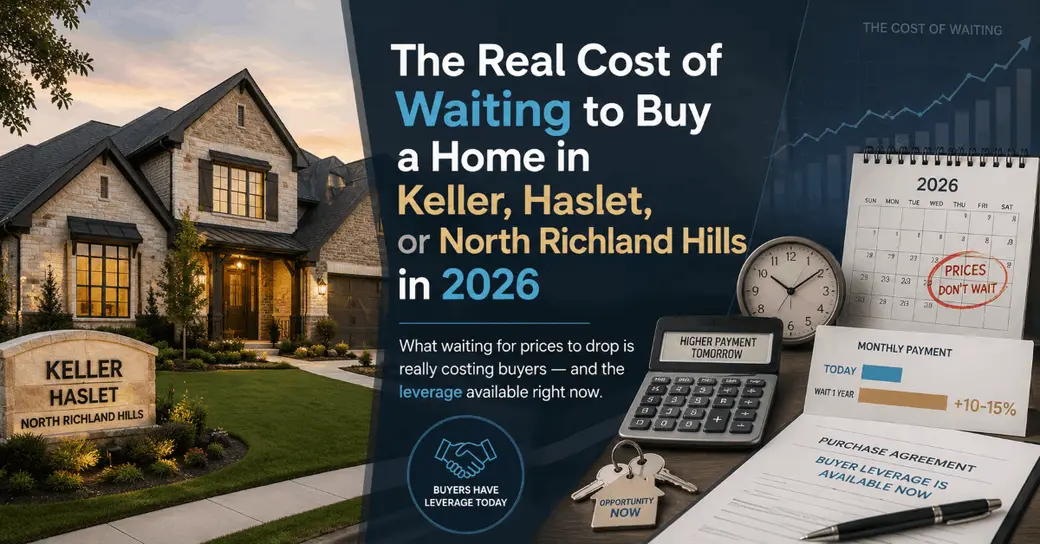
Quick Answer: In North Texas's current market, buyers have negotiating leverage — on price, concessions, rate buy-downs, and repair credits — that didn't exist in 2021 or 2022. Whether waiting for further price declines makes financial sense depends on a specific calculation most buyers never run: the combined cost of continued rent, potential price movement, and rate risk against the actual savings they're expecting. This article is educational context — consult a licensed real estate professional and lender before making purchasing decisions.
This is where people get stuck. Not in the decision to buy. In the waiting.
They watch prices soften, they hear a forecaster mention further declines, and the mental math feels obvious: wait a little longer, save a little more, buy at the bottom. The problem is the bottom isn't announced in advance. And while you're calculating it, the cost of waiting is accumulating in ways that don't show up in a headline.
The Calculation Most Buyers Never Run
Waiting to buy has a real cost. It's just spread across enough line items that it's easy to ignore.
Start with the simple version. Current 30-year fixed rates in Texas are running at 6.60% as of June 2026, per Bankrate. If you're targeting a $450,000 home and prices decline another 3% before you buy, you save $13,500 on the purchase price. That's real money.
But here's what else happens during the wait. You keep paying rent — the median monthly payment on a new purchase was around $2,152 nationally as of April 2026 per the Mortgage Bankers Association, but rent in the Keller and North Richland Hills corridor for a comparable property runs in a similar range or higher. Every month of rent is a sunk cost with no equity return. At $2,200 a month, six months of waiting costs $13,200 before you've bought anything. You've nearly offset the entire price decline you were waiting for before the first mortgage payment clears.
Then there's the rate dimension. Most forecasters expect 30-year rates to drift modestly lower through late 2026 — expert consensus cited by multiple sources puts a possible year-end range in the high 5s to low 6s, though nothing is guaranteed and rates recently jumped to nine-month highs amid renewed economic uncertainty per Redfin's June 2026 market commentary. If rates move against you while you wait, a 0.5% rate increase on a $436,500 loan (your $450K home after the 3% decline) adds roughly $150 per month to your payment for the life of the loan. The price savings evaporate in under eight years.
Reality Check: The math on waiting isn't inherently wrong. It's that most buyers run only the optimistic half of it — the price decline they're hoping for — without running the rent cost, rate risk, and opportunity cost on the other side. Run the full calculation with your lender before you make a timeline decision based on a partial picture.
The Leverage That Exists Right Now — and Why It Won't Always
Here's what most buyers in 2021 and 2022 would have paid to have: the ability to negotiate.
The North Texas market in mid-2026 has extended days on market, rising inventory in several submarkets, and sellers who know they're not receiving five offers in the first weekend. That combination produces something that hasn't been consistently available in this market for several years — genuine buyer leverage at the negotiating table.
In a market where sellers are motivated and inventory is sitting, the real opportunity isn't waiting for a lower list price. It's what happens after you go under contract. Seller concessions — credits toward closing costs, permanent or temporary rate buy-downs, repair credits — are where meaningful savings are available right now without requiring prices to fall further.
In Texas, closing costs for a buyer typically run 2% to 3% of the purchase price. On a $450,000 home, that's $9,000 to $13,500. In the current North Texas market, motivated sellers are regularly covering a meaningful portion of those costs as a concession — costs they wouldn't have absorbed in 2021 at all. A seller-paid 2-1 temporary rate buy-down on a $400,000 loan at current rates saves a buyer real money in the first two years of ownership and costs the seller roughly the equivalent of a modest price reduction, making it an easier yes.
Pro Tip: A closing cost concession is frequently more valuable than a price reduction of the same dollar amount. A $10,000 price reduction lowers your loan amount by $10,000 and saves you roughly $55 per month on a 30-year fixed. A $10,000 closing cost credit reduces your out-of-pocket cash at closing by the full $10,000 immediately. In a market where cash-to-close is often the binding constraint for buyers, the concession structure matters as much as the number.
What "Buying With Leverage" Actually Looks Like in Keller, Haslet, and NRH
This isn't abstract. Here's what's negotiable in this market that wasn't in 2022.
The owner's title insurance policy in Texas runs approximately 0.6% of the purchase price by convention — typically paid by the seller. In a competitive market, buyers didn't push on it. In the current market, it's a standard ask and sellers are saying yes. On a $450,000 purchase, that's roughly $2,700 you're not paying out of pocket.
Inspection repairs and repair credits are back on the table. In 2021 and 2022, buyers were waiving inspections entirely in some cases. Today, inspection contingencies are standard, repair requests are being negotiated, and sellers who want to close are engaging rather than walking.
Rate buy-downs — either permanent or temporary 2-1 structures — are being offered by motivated sellers as an alternative to price reductions. A temporary 2-1 buy-down brings your effective rate down in years one and two, reducing your initial payment and giving you time to refinance if rates move lower. It costs the seller roughly the same as a price cut but delivers more immediate monthly impact to the buyer.
What Most Buyers Miss: The leverage available right now is not permanent. Most forecasters expect inventory to tighten and buyer competition to increase as rates ease and demand that's been sitting on the sidelines re-enters the market. The concession environment you have access to today exists because of specific market conditions. Those conditions don't last indefinitely.
The Refinance Option — and What It Actually Requires
A common objection to buying now at 6.60% is the rate itself. The counter-argument you'll hear is "date the rate, marry the house" — buy now and refinance when rates fall. That's not wrong, but it requires a clear-eyed look at what refinancing actually costs and when it makes sense.
A refinance typically costs 2% to 3% of the loan amount in closing costs. On a $360,000 loan (80% of a $450,000 purchase), that's $7,200 to $10,800 out of pocket or rolled into the new loan. The break-even on that cost depends on how much your monthly payment drops. A 0.75% rate reduction on a $360,000 loan saves roughly $170 per month — meaning you'd break even on refinancing costs in approximately four to five years at that savings level.
If you're buying in Keller or Haslet with a five-plus-year hold horizon, the refinance option is a real and viable part of the plan. If you're uncertain about your timeline, the math on refinancing looks different. Know your number before you rely on it as a reason to buy.
FAQs
Is now a good time to buy a home in Keller, Haslet, or North Richland Hills in 2026?
It depends on your specific financial situation, hold timeline, and what you're purchasing. The current market offers buyer leverage — on price, concessions, and terms — that wasn't available in 2021 or 2022. Whether that leverage makes buying the right decision for you requires a conversation with a licensed real estate professional and your lender about your specific numbers.
What are seller concessions and how do I ask for them in North Texas?
Seller concessions are credits the seller agrees to pay toward your closing costs, rate buy-downs, or repairs as part of the transaction. In the current North Texas market, they're standard asks in negotiations where the seller is motivated and the home has been on market. Work with your agent to structure the request based on the specific property, days on market, and seller situation. In Texas, conventional loan limits on seller concessions vary based on down payment percentage — confirm the applicable limit with your lender.
How much could I save in concessions vs. waiting for a price drop?
That depends on the specific property and negotiation, but closing costs on a $450,000 purchase run $9,000 to $13,500. A seller covering a meaningful portion of that — combined with a negotiated repair credit or rate buy-down — can deliver savings equivalent to a 2% to 3% price reduction without requiring prices to fall at all. Run both scenarios with your agent and lender before deciding which path produces the better outcome for your situation.
What happens to my buying power if mortgage rates rise while I wait?
A 0.5% rate increase on a $360,000 loan adds approximately $105 to $110 per month to your payment and roughly $38,000 in total interest over 30 years. Whether rates will rise, fall, or stay flat is genuinely uncertain — forecasters disagree and recent economic volatility has pushed rates to nine-month highs as of mid-2026. Factor rate risk into your waiting calculation, not just price direction.
Should I try to time the market bottom before buying?
Market bottoms aren't visible until after they've passed. The more productive frame is whether a specific home, at a specific price, with the concessions and terms available today, makes financial sense for your situation and hold period. That's a calculable question. "Is this the bottom?" is not.
A note on this content: This article is educational and informational only. It does not constitute legal, tax, financial, or investment advice. Mortgage rate figures, market data, and concession estimates reflect sources available at time of writing and may have changed. Rates cited are from Bankrate as of June 8, 2026 and will move — verify current rates with your lender before making any financial calculations. For current North Texas market data, verify through MetroTex at mymetrotex.com. Consult a licensed real estate professional and mortgage lender before making purchasing decisions.
Ready to talk through your next move? Schedule a conversation at WisemoveTX.com.
Joy Rhodes | REALTOR® WisemoveTX.com joy@wisemovetx.com TX License #0622809
Categories
- All Blogs (65)
- Commercial / Investors (20)
- Equity & Investment Strategy (5)
- Family & Community (6)
- Food & Dining (3)
- Market Insights (25)
- Neighborhood Spotlights (11)
- North Fort Worth Growth & Development (6)
- North Texas Living (15)
- Outdoor Life & Recreation (4)
- Residential Buyers (27)
- Residential Sellers (24)
Recent Posts