Flex Space Near Alliance: Why Sophisticated Investors Keep Coming Back to This Corridor
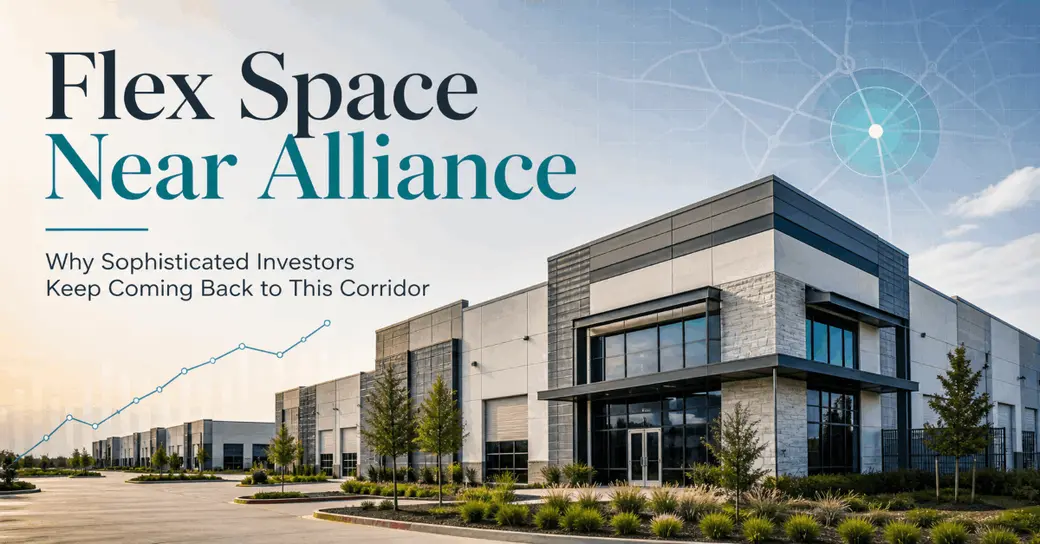
QUICK ANSWER Flex space near the Alliance corridor in North Fort Worth continues to attract experienced investors because of a structural supply-demand imbalance: small-bay flex is critically undersupplied while the surrounding labor ecosystem — 602 companies, 73,000+ jobs — keeps demand for service-oriented space persistently elevated.
If I'm being honest, most of the investors who come to me about Alliance already know the headline story. They know DFW is the top U.S. market for commercial real estate investment — PwC and Urban Land Institute ranked it there again in their 2026 Emerging Trends report, and they've held that position consistently. What they want to know is whether there's still a real play in flex space specifically, or whether they've waited too long.
The short answer: the window isn't closed. The longer answer is why — and why the investors who understand the structural dynamics here keep coming back instead of chasing the next headline market.
The Alliance Ecosystem Is Bigger Than Most Investors Realize
People hear "Alliance" and they think about the big-box industrial names — Amazon Air, FedEx, Embraer, the BNSF intermodal facility. Those are real. But the story that matters for flex investors isn't the headline tenants. It's the secondary and tertiary ecosystem those tenants generate.
AllianceTexas — the 27,000-acre master-planned development anchored by Perot Field Fort Worth Alliance Airport — reported 602 companies and more than 73,000 jobs in 2025, according to a February 2026 Community Impact report citing Hillwood's annual update to the Fort Worth City Council. The 2025 annual economic impact was $12.9 billion. Cumulative regional economic impact since the development opened 36 years ago now stands at $142.9 billion.
Those aren't round numbers for a press release. They represent a tenant ecosystem — suppliers, service providers, last-mile logistics operators, specialty contractors — that needs space. Not 500,000-square-foot big-box space. Small-bay flex space. The kind of building a 10-person electrical contractor or a custom fabricator or a regional HVAC service company actually occupies. That demand is persistent, and it doesn't track the headlines.
Local Note: The municipalities surrounding Alliance — Haslet, Northlake, Roanoke, and Justin — are themselves in active growth phases. Each of them is adding residential inventory, which generates its own secondary service demand: contractors, trades, medical offices, specialty retail. Flex space serves all of it. The corridor isn't one market — it's several layered on top of each other.
Why Flex Outperforms When Big-Box Gets Oversupplied
Here's the dynamic worth understanding right now. Hillwood announced in April 2026 that its speculative industrial pipeline at AllianceTexas is the largest in the development's history — 3.1 million square feet under construction and another 2.6 million square feet in predevelopment, per Fort Worth Inc. DFW leads the country in industrial space under construction at 28.8 million square feet, according to CommercialSearch data cited by the Fort Worth Report.
That sounds like a supply story. And for 300,000-square-foot logistics buildings, it partially is. But flex space operates in a different supply cycle.
Small-bay industrial — typically defined as multi-tenant spaces under 20,000 square feet — is structurally undersupplied in high-growth corridors across Texas, not because developers aren't interested, but because the economics of building it are less forgiving and the land economics near Alliance have made large-format spec industrial the easier build. The result: the tenants who need small-bay flex space have fewer options than the market broadly suggests.
Reality Check: Not all industrial is the same play. If you're evaluating a 400,000-square-foot spec warehouse near Alliance, you're in a different conversation than if you're evaluating a 12-unit flex park in Haslet or Justin. Big-box industrial has real vacancy risk in an oversupplied cycle. Small-bay flex has a different demand profile — and right now, a tighter one. Know which product type you're actually underwriting before comparing cap rates across asset classes.
The Numbers on the Corridor Right Now
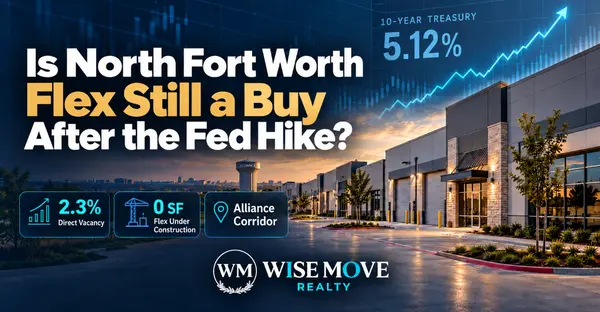
DFW-wide industrial rents sit at approximately $8.12 per square foot with overall vacancy near 8.8%, according to Q4 2025 data from CoStar-cited industry reporting. Flex industrial specifically has been tighter — CBRE reported flex vacancy declining toward 6% in early 2025, compared to the broader industrial market.
Cap rates for prime industrial near Alliance have been trading in the 5.5 to 6 percent range for stabilized assets, with older or off-corridor properties in the 7 percent range. Debt is real in this environment: LTVs are running 50 to 65 percent with rates north of 6.5 percent depending on the deal structure, which means the acquisition math is tighter than it was in 2021. Deals still work, but the underwriting discipline matters more than it did when rates were at the floor.
Pro Tip: The investors I've seen execute well in this corridor lately are buying existing, partially-occupied flex parks rather than developing from scratch. The entry point is cleaner, the basis is known, and the value-add thesis — lease-up to market rents in a supply-constrained submarket — is easier to underwrite than a spec construction timeline in a rate environment like this one.
Why Investors Who Understand This Market Stay In It
The Alliance corridor has a characteristic that's genuinely rare in commercial real estate: infrastructure density that is already built. Perot Field is purpose-built for industrial aviation. The BNSF intermodal facility is operational. I-35W and SH-170 already connect. These are not promises — they are in place, functioning, and attracting the kind of corporate presence that doesn't reverse.
Wistron, MP Materials, and Embraer all have operations in the corridor. SGS Studios is there. These aren't speculative tenants. And as those operations scale, so does the demand for the service infrastructure around them — the subcontractors, the parts suppliers, the operations-support businesses that need 3,000 to 12,000 square feet of functional flex space near their clients.
The sophisticated investors who keep coming back here aren't chasing yield on a moment-in-time market. They're buying into a structural dynamic they've watched play out across other high-growth corridors. The difference with Alliance is that the infrastructure bet has already paid off. What's left is the compounding effect.
What Most Investors Miss: The Alliance corridor isn't one market — it spans Tarrant and Denton counties across nine municipalities, each at a different point in its development cycle. Haslet, Northlake, and Justin each have different land economics, different zoning contexts, and different demand profiles. A flex park that works in Haslet's established industrial corridor is a different investment thesis than one on the Justin FM 156 edge where development density is still catching up to infrastructure. Granularity matters here more than the corridor-level narrative.
What I'd Tell You Before You Commit Capital Here
I'm not in the business of selling a narrative. I work this market every day, and I'll tell you what I actually see. The flex play near Alliance is real — the demand drivers are structural, the supply constraints are genuine, and the corridor's foundational infrastructure isn't going anywhere. The opportunity is not the same as it was in 2019, and the deal math isn't as easy as it was in 2021.
What's different now is that the patient capital wins more decisively. The investors who are underwriting conservatively, buying into cash-flowing or near-cash-flowing assets, and thinking in five-to-seven-year hold periods are finding deals. The investors chasing compressed cap rates on spec plays with 2021 assumptions are struggling.
If you're evaluating a specific property or trying to get a real read on what's available and what's actually trading, that's a conversation worth having before you start making calls to brokers who have one outcome in mind.
Common Questions
What exactly is flex space, and why is it different from regular industrial?
Flex space is a hybrid building format — typically single-story, with professional office or showroom space in the front and a functional warehouse component in the back, including high ceilings and roll-up doors. It's designed for tenants who need both a customer-facing presence and operational square footage: contractors, distributors, specialty service businesses, light manufacturers. Unlike a pure warehouse, it can serve a broader range of tenants. Unlike a pure office, it's not vulnerable to the same remote-work headwinds. That versatility is exactly why demand for it stays relatively stable across economic cycles.
Has the Alliance corridor already peaked for investors?
For large-format spec industrial with long lease-up timelines and aggressive underwriting assumptions — possibly. For well-located small-bay flex with existing occupancy and conservative hold assumptions — no. The macro growth story for Alliance is not over — Hillwood announced its largest-ever speculative industrial pipeline in April 2026, and PwC/ULI ranked DFW the top U.S. CRE market again in their 2026 report. The question isn't whether the corridor is growing. It's whether the specific asset and deal structure you're evaluating makes sense given current debt costs and your exit timeline.
What are realistic cap rates for flex space near Alliance right now?
Based on current industry reporting, prime stabilized industrial and flex assets near Alliance are trading in the 5.5 to 6 percent range. Older product or properties with lease-up risk are pricing in the 6.5 to 7 percent range. These are broker-reported figures — verify current comps with a licensed commercial broker before underwriting any specific deal, as individual properties vary significantly based on location, condition, tenant quality, and lease structure.
Is Haslet or Northlake a better location for flex space investment?
They're different plays. Haslet has a more established industrial corridor with existing comp data and a proven tenant base — lower risk, smaller spread. Northlake is earlier in its development cycle with more volatility in both directions — higher potential upside if you get the timing right, more execution risk on lease-up. Neither is categorically better. It depends on your risk tolerance, hold period, and whether you're buying existing cash flow or building toward it.
Should I use a 1031 exchange to get into Alliance corridor flex space?
A 1031 exchange can make strong economic sense in this corridor — particularly if you're rolling appreciated residential or industrial assets into a higher-yield commercial position. The mechanics of a 1031 are time-constrained: you have 45 days to identify replacement property and 180 days to close after selling your relinquished asset. That timeline is real pressure in a market where good flex inventory moves. If you're considering a 1031 into this corridor, the conversation about replacement property needs to start before you sell, not after. Confirm the exchange structure with your CPA and qualified intermediary before committing to any timeline.
The Alliance corridor is one of the most proven commercial real estate bets in the Sun Belt — not because of what's coming, but because of what's already there. The infrastructure is built. The tenant ecosystem is deep. The demand for service-oriented flex space isn't speculative; it's generated daily by 73,000 workers who need the businesses that support them to be nearby.
What separates the investors who execute well here from the ones who don't isn't access to information — it's ground-level market intelligence and the discipline to underwrite what's real instead of what the narrative suggests. That's exactly the kind of conversation I'm built for.
Ready to talk through your next move? Schedule a conversation at WisemoveTX.com.
Categories
- All Blogs (65)
- Commercial / Investors (20)
- Equity & Investment Strategy (5)
- Family & Community (6)
- Food & Dining (3)
- Market Insights (25)
- Neighborhood Spotlights (11)
- North Fort Worth Growth & Development (6)
- North Texas Living (15)
- Outdoor Life & Recreation (4)
- Residential Buyers (27)
- Residential Sellers (24)
Recent Posts