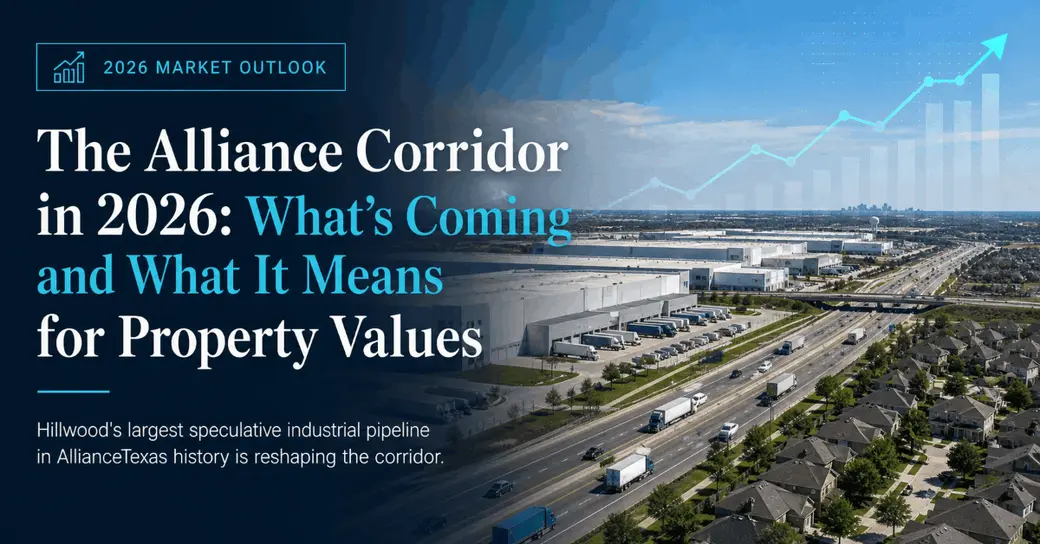
The Alliance Corridor in 2026: What's Coming and What It Means for Property Values
Quick Answer: The Alliance corridor is in its most aggressive commercial expansion phase since inception — 5 buildings currently under construction totaling 3.1 million square feet, with another 2.6 million square feet in predevelopment. For homeowners and buyers in Haslet, Northlake, and surrounding communities, sustained job creation continues to support residential demand, though the broader DFW market remains in a buyer-friendly adjustment period in 2026.
The Alliance corridor doesn't slow down. It just changes what it's building.
In 2026, what's being built is significant — and if you own property near it, or you're thinking about buying here, you need to understand what's actually happening before you form an opinion based on second-hand noise.
Here's the honest read.
What Hillwood Just Announced — And Why It Matters
This is the part most residents haven't heard yet.
Hillwood has started construction on Alliance Gateway 70 and Alliance Gateway 71, two new speculative industrial buildings located at the intersection of Independence Parkway and Henrietta Creek, near SH 170. Gateway 70 is 268,623 square feet. Gateway 71 is 501,235 square feet. Together with Alliance Westport 12, Alliance Westport 15, and Alliance Gateway 34, Hillwood now has five buildings under construction — totaling 3.1 million square feet — marking the largest speculative industrial pipeline in the development's history.
That's not a typo. Largest in the development's history. At a 27,000-acre master-planned project that's been running since 1989.
Local Note: "Speculative" industrial means Hillwood is building without a tenant already signed. That's a meaningful signal. Developers don't pour capital into spec construction unless they have strong conviction that demand will absorb it. At Alliance, that conviction is well-earned. Recent examples include Southwire, SGS Studios, and Wistron — all of which began as speculative projects and became occupied facilities.
The Autonomous Freight District Nobody's Talking About
One development that deserves far more attention than it's getting is the Alliance Logistics District.
A first-of-its-kind transportation district for bulk operations launched in North Texas as a partnership between BNSF Railway, Hillwood, and the city of Fort Worth. It consists of three streets — Mobility Way, Distribution Drive, and Intermodal Parkway — designed exclusively for cargo vehicles, with the goal of enabling faster, more cost-effective movement through autonomous and semi-autonomous freight shuttles.
Aurora, an autonomous vehicle company, is operating self-driving trucks within the district. Hillwood is also investing in a new $20 million three-lane bridge to connect the BNSF intermodal facility and Alliance's container depot.
This isn't a pilot program. This is infrastructure being permanently built into the corridor. The companies it attracts — logistics, automation, advanced manufacturing — tend to bring stable, high-paying employment. That matters for residential real estate in ways that take a few years to fully show up in the data, but the signal is there now for anyone paying attention.
What Most Investors Miss: The residential real estate story in this corridor has always been downstream of the commercial story. When major employers commit capital to permanent infrastructure, workforce relocation follows. That workforce needs housing. In Haslet, Northlake, and Justin, the inventory is there. The question is timing.
The Residential Market Right Now — Honest Numbers
Here's where I'm going to give you the truth that the enthusiastic development headlines leave out.
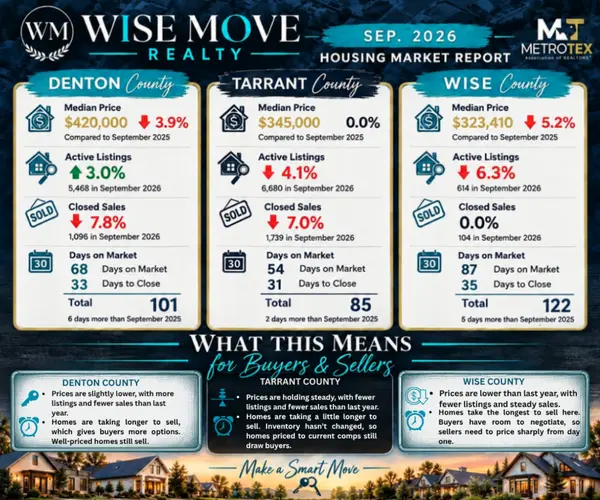
The broader DFW market is in a correction. Fort Worth home values currently sit around $295,822, down roughly 3% year over year from 2025. Mortgage rates have stayed stubbornly above 6%, which has compressed buyer pools and extended days on market across the metro. Haslet's average home value is sitting at approximately $385,364, down about 2.9% over the past year, with homes going to pending in around 64 days — which is notably longer than the frenzied pace of 2021 and 2022.
This is not a crisis. It's a normalization.
Fort Worth's housing market is holding steady rather than collapsing — not exploding, but not in freefall either. That stability is a function of exactly what's happening at Alliance: sustained job creation and ongoing corporate investment act as a floor under residential demand even when rates push buyers to the sidelines.
Reality Check: If you bought in this corridor in 2020 or 2021, your equity position is still dramatically ahead of where it was pre-pandemic — Fort Worth values remain roughly 25% higher than they were in 2021. A 3% year-over-year dip in a market that ran up 30%+ is not a red flag. It's math working itself out.
What the Commercial Expansion Actually Does to Residential Values
This is the relationship most people don't think clearly about.
Commercial development near Alliance doesn't immediately pop residential prices in Haslet or Northlake. What it does is create long-term demand density. AllianceTexas has attracted more than 575 companies and created over 73,000 jobs, generating an estimated $123 billion in economic impact since inception. Those aren't abstract statistics — they're commuters, renters, buyers, and families who need to live within a reasonable distance of where they work.
The communities closest to the logistics and industrial core — Haslet especially, with direct access to SH 287 and I-35W — tend to capture workforce housing demand before it moves further out toward Justin or Decatur. Northlake captures a different buyer: the professional who wants more land and the Argyle or Northwest ISD school district, and is willing to add ten minutes to the commute to get it.
Neither story is broken. They're just different stories.
Pro Tip: If you're evaluating a purchase in the corridor right now, the question isn't whether the Alliance development is real. It demonstrably is. The question is how much time you have. This is a long-thesis market. Buyers who plan to own for five to ten years have a very different risk profile than buyers who need to sell in two.
New Construction vs. Resale — Where the Tension Is
One thing worth naming directly: the new construction pipeline in this corridor is massive.
Northlake alone has multiple large master-planned communities — Pecan Square, Harvest, Canyon Falls — adding inventory steadily. In 2026, there's high demand for move-in ready spec homes from buyers escaping rising rents, while custom ground-up starts remain the choice for those seeking specific school district zoning. Builders are competing aggressively, offering rate buydowns and incentives that resale sellers simply can't match dollar-for-dollar.
For resale homeowners in Haslet and Northlake, this is the real competitive pressure in 2026. Not the macro headlines. The builder next door with a rate buydown offer.
If you're selling, your price-per-square-foot has to account for what new construction is doing in your micro-market. If you're buying, understand the trade-off: resale typically means an established neighborhood, mature trees, and a location that's already proven. New construction means a builder warranty and a rate incentive, often in a community that won't fully stabilize for another three to five years.
Neither is wrong. Both require clear-eyed thinking about what you're actually buying.
Frequently Asked Questions
Does the Alliance corridor development directly increase home values in Haslet and Northlake?
Not immediately and not automatically. Commercial expansion creates job density, which creates residential demand over time. The Alliance corridor has generated more than 73,000 jobs and attracted over 575 companies — that sustained employment base is what supports residential demand in the surrounding communities. The impact on specific prices depends on location relative to the development, school district, and inventory levels in each submarket. Think of it as a long-term structural floor, not a short-term price catalyst.
Are home prices dropping near Alliance in 2026?
Yes, modestly — consistent with the broader DFW market. Haslet is down approximately 2.9% year over year according to Zillow data. That said, these communities remain significantly above their pre-pandemic baselines, and the job creation driven by Alliance continues to support underlying demand. A 2–3% correction in a market that appreciated 30%+ is a normalization, not a reversal.
What is the Alliance Logistics District and why should homeowners care?
The Alliance Logistics District is a first-of-its-kind freight movement district enabling autonomous and heavy-haul vehicle operations on dedicated streets — Mobility Way, Distribution Drive, and Intermodal Parkway — within the AllianceTexas development. It's designed to attract logistics, automation, and advanced manufacturing tenants. For homeowners, it matters because the type of employer it recruits — stable, technology-oriented, well-compensating — tends to generate sustained residential demand in nearby communities, particularly for workforce housing in Haslet and entry-level product in Justin.
Is now a good time to buy in the Alliance corridor?
That depends entirely on your timeline. If you're buying to own for five-plus years, the fundamentals here are stronger than almost anywhere else in DFW — sustained employer investment, population growth, and a school district landscape that continues to attract families. If you need liquidity in two years, the current market conditions require more care. Rates are still elevated, new construction competition is real, and buyer pools are thinner than they were in 2022. The honest answer: the corridor is sound. Your circumstances determine whether now is right for you.
What's actually being built near Alliance right now?
DFW leads the entire country for industrial real estate under construction at the start of 2026, with 28.8 million square feet currently in development across the metro. Within AllianceTexas specifically, Hillwood has five speculative industrial buildings under construction totaling 3.1 million square feet, with another 2.6 million in predevelopment. Additionally, the Alliance Logistics District is operational, a new $20 million BNSF bridge is under construction, and multiple residential master-planned communities continue adding homes across Northlake and Haslet.
The Bottom Line
The Alliance corridor in 2026 is not a story about hype finally catching up to reality. It's the opposite. The development is real, it's documented, and it's at the largest scale in the project's history. What the corridor needs — what it's always needed — is time for residential values to fully reflect that commercial foundation.
The macro market is soft right now. Rates are elevated, buyers are cautious, and sellers in this corridor are competing with builder incentives. None of that changes the underlying thesis. This is still one of the most economically grounded submarkets in North Texas, and the employers anchoring it are not going anywhere.
If you're trying to decide what to do with property here — or whether to buy here — the question isn't about the corridor. The question is about your own timing, liquidity, and goals.
Ready to talk through your next move? Schedule a conversation at WisemoveTX.com.
Data sources: Community Impact (April 2026), Fort Worth Report (April 2026), Fort Worth Inc., Hillwood/AllianceTexas press releases, Zillow Home Value Index, Greater Fort Worth Association of Realtors. Market figures should be verified against current MLS data and NTREIS/Matrix before use in any client-facing context.
Categories
- All Blogs (65)
- Commercial / Investors (20)
- Equity & Investment Strategy (5)
- Family & Community (6)
- Food & Dining (3)
- Market Insights (25)
- Neighborhood Spotlights (11)
- North Fort Worth Growth & Development (6)
- North Texas Living (15)
- Outdoor Life & Recreation (4)
- Residential Buyers (27)
- Residential Sellers (24)
Recent Posts