Is North Fort Worth Flex Still a Buy After the Fed Hike?
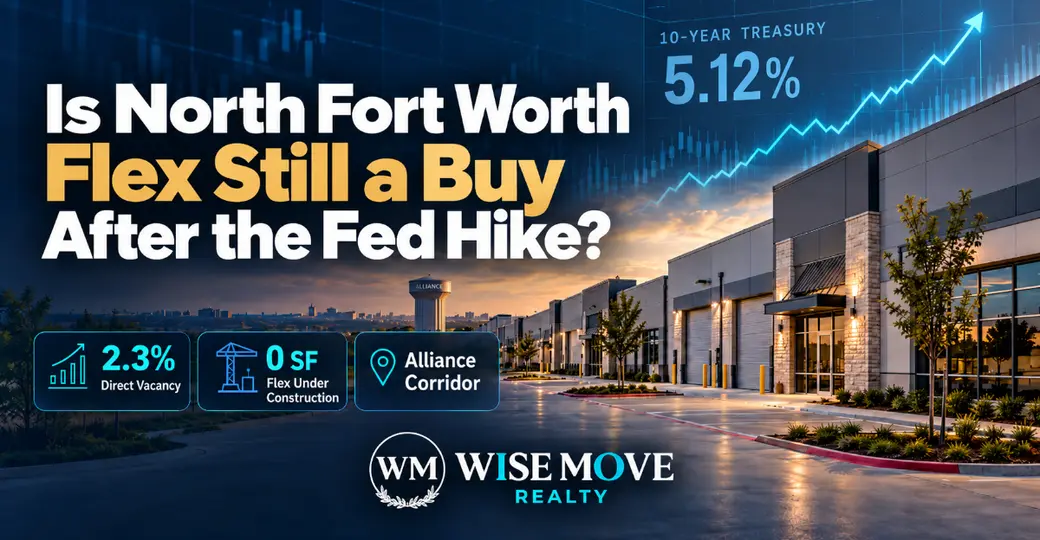
Quick Answer: For the right buyer, yes. North Fort Worth flex sat at 2.3% direct vacancy in Q2 2026 with nothing under construction, and higher rates make new supply harder to build. But with long-term borrowing costs this high, leverage barely helps returns, so the deal has to work on income growth.
Unpopular opinion: The Fed's September rate hike was good news for anyone who already owns flex space in North Fort Worth.
It's harder news for anyone trying to buy it with borrowed money. Both things are true at once, and the investors who do well over the next two years will be the ones who understand why.
What Did the Fed Hike Change for North Fort Worth Flex Investors?
The Fed raised its benchmark rate a quarter point on September 16, to a range of 3.75% to 4.00%. That's the headline. It's not the number that prices your loan.
Commercial debt prices off the 10-year Treasury, and the 10-year is the real story. In late September and early October 2026, it climbed above 5%, reaching its highest level since 2002.
Here's why that matters. In mid-September, Marcus & Millichap estimated the spread between average cap rates and the 10-year had narrowed to about 180 basis points. When the spread gets that thin, borrowed money stops doing much for your return. The deal has to work on the income itself.
Reality Check: Today's rates aren't abnormal. Marcus & Millichap puts the 70-year average 10-year yield near 5.6%. What was abnormal was the decade of cheap money that a lot of pro formas were built on. If your underwriting still assumes it's coming back, that's the assumption to stress-test first.
Why Is North Fort Worth Flex So Tight?
North Fort Worth has roughly 5 million square feet of flex and R&D space in buildings of 25,000 square feet and up. In the second quarter, Transwestern reported direct vacancy at 2.3% and availability at 4.4%. The DFW flex average was 5.9%. Asking rents in the submarket ran $15.54 per square foot NNN, above the metro's $15.09.
And the number that matters most: zero square feet of flex under construction.
That's a striking contrast with the rest of the corridor. North Fort Worth has more than 9.1 million square feet of warehouse space under construction, more than any submarket in the metro, much of it build-to-suit. That includes a Lennox facility at 4 Haslet County Road. Demand for big space is real, too. Novolex signed a lease for more than 1 million square feet at 114 Logistics Park in the second quarter.
The corridor is growing from the top down. Big-box users come first. The contractors, suppliers, service companies, and small manufacturers that work alongside them tend to follow, and they don't need 500,000 square feet. They need 5,000 to 25,000, close to the work.
Local Note: The warehouse pipeline gets the headlines, but it isn't competing with flex. A 1-million-square-foot distribution center and a 15,000-square-foot flex suite serve different tenants. If anything, the first one creates demand for the second.
How Do Higher Rates Protect Existing Flex?
They make it harder to build the competition.
Construction loans price off the same rising benchmarks as everything else. Developers were already pulling back before the hike. Of the 33.5 million square feet under construction across DFW in the second quarter, only about 41% was preleased, and Transwestern noted that new starts had slowed considerably as developers leaned toward build-to-suit projects.
Multi-tenant flex is the hardest product to justify in that environment. It's speculative by nature. You build it, then you lease it suite by suite. When construction debt costs more and lenders want preleasing, that math gets difficult fast.
So the existing buildings get more valuable in a specific way. Their replacement cost rises, and replacement cost is what keeps a new competitor from undercutting your rents.
Pro Tip: Underwrite an existing flex acquisition against what it would cost to build today, not against last year's sale comps. If your basis sits well below replacement cost in a submarket with no new supply coming, you have a margin of safety the rate environment can't easily take away.
Where Does Retail Fit in a Higher-Rate Market?
Retail is telling a similar story at the metro level. Weitzman's midyear report put DFW retail occupancy at a record 95.3% through the first half of 2026. If it holds above 95% through year-end, it'll be only the fourth time that's happened since Weitzman began tracking the market in 1990.
New retail is being built, roughly 75% more this year than last. But Weitzman describes the pipeline as conservative for a market this full, which is why retailers looking to expand have often had to fill existing space instead. Most of what is getting built is grocery-anchored.
The logic mirrors flex. When new supply is constrained and occupancy is high, existing well-located centers hold their pricing power, and higher construction costs reinforce that.
Reality Check: These are metro-wide figures. Retail performance varies sharply by trade area, and a center's value depends on its anchor, its traffic counts, and the rooftops around it. The corridor's household growth is a tailwind, but underwrite the specific center, not the metro average.
What Could Break the Flex Thesis?
If I'm being honest, the tightness in North Fort Worth flex is about supply, not surging demand. Net absorption for the submarket's flex space was negative over the past year, about 33,000 square feet. Vacancy is low because nothing new is being built, not because tenants are lining up.
That matters, because a supply-driven thesis has a different weak point. It's a small market. With roughly 5 million square feet tracked, a single 100,000-square-foot move-out would push vacancy up about two percentage points. One tenant can change the picture.
The data has a blind spot, too. Transwestern tracks buildings of 25,000 square feet and larger, so smaller multi-tenant flex isn't in these numbers. If that's what you're buying, you need building-level leasing history, not submarket averages.
And the rate path isn't settled. Sixteen of 18 Fed policymakers projected at least one more hike this year. Markets have pushed the odds toward December, but nobody should underwrite a rate cut into a 2027 exit.
What Most Investors Miss: Higher rates also create sellers. Marcus & Millichap estimates about $865 billion in commercial real estate debt matures in 2026 and another $645 billion in 2027. Owners who financed at 2021 rates and can't refinance at today's will need to sell or bring cash. Buyers with low leverage and patience are the ones positioned to meet them.
FAQs
What is the flex vacancy rate in North Fort Worth?
Transwestern reported North Fort Worth flex and R&D direct vacancy at 2.3% in the second quarter of 2026, with availability at 4.4%. That compares with 5.9% direct vacancy for flex across DFW. The figures cover buildings of 25,000 square feet and larger.
How does the 10-year Treasury affect commercial real estate?
Most commercial mortgages are priced off the 10-year Treasury yield, so when it rises, borrowing costs rise with it. A higher 10-year also narrows the spread between cap rates and risk-free returns, which can pressure property values. In early October 2026, it reached its highest level since 2002.
Is new flex space being built near Alliance?
Not currently. Transwestern's second-quarter 2026 report showed no flex or R&D space under construction in the North Fort Worth submarket. New construction there is concentrated in large warehouse and build-to-suit projects, with more than 9.1 million square feet underway.
Is DFW retail still a strong investment in 2026?
Metro fundamentals are strong. Weitzman reported record DFW retail occupancy of 95.3% through the first half of 2026, with new construction concentrated in grocery-anchored centers. Individual results depend heavily on the specific center, its anchor tenant, and its trade area.
Will commercial borrowing costs come down by the end of 2026?
It looks unlikely. The Fed raised rates in September, most policymakers projected another hike this year, and the 10-year Treasury reached its highest level since 2002 in early October. Commercial loan pricing follows the 10-year, which can move with inflation data and Treasury supply regardless of what the Fed does.
The Bottom Line on North Fort Worth Flex
The Fed hike didn't break the case for flex in North Fort Worth. It changed who it works for. Low vacancy and no new supply make existing buildings worth owning, and higher construction costs protect that position. But with long-term borrowing costs this high, leverage won't carry the return. The buyers who win here are the ones buying below replacement cost, underwriting real income growth, and keeping enough equity in the deal to ride out whatever the next few Fed meetings bring.
Considering a flex or retail acquisition along the Alliance corridor? Schedule a conversation at WisemoveTX.com.
Joy Rhodes | REALTOR®
WisemoveTX.com
joy@wisemovetx.com
TX License #0622809
Categories
- All Blogs (65)
- Commercial / Investors (20)
- Equity & Investment Strategy (5)
- Family & Community (6)
- Food & Dining (3)
- Market Insights (25)
- Neighborhood Spotlights (11)
- North Fort Worth Growth & Development (6)
- North Texas Living (15)
- Outdoor Life & Recreation (4)
- Residential Buyers (27)
- Residential Sellers (24)
Recent Posts