What Does the Fed Hike Mean for Keller Buyers and Sellers?
Quick Answer: The Fed's September hike helped push 30-year mortgage rates to 7.28%, the highest since 2023. In Tarrant County, inventory is tighter than a year ago, but sales and the median price are down. Neither buyers nor sellers hold the leverage statewide headlines suggest.
Here's the truth most people won't say. The headlines about the Fed's rate hike weren't written for Keller.
They were written for Texas as a whole, and Texas as a whole isn't your market. If you're buying, they're telling you the leverage is all yours. If you're selling, they're telling you to brace for price cuts. On the Fort Worth side of DFW, the numbers tell a different story, and it matters which side of the table you're on.
How Did the Fed Hike Change the Keller Market?
On September 16, the Federal Reserve raised its benchmark rate a quarter point to a range of 3.75% to 4.00%. It was the first hike since July 2023, and the vote was unanimous. Mortgage rates had already been climbing ahead of it. By October 1, Freddie Mac's 30-year average hit 7.28%, the highest since November 2023.
That part is real. Where the headlines go wrong is what comes next. The statewide story is a buyer's market with 5.5 months of supply and sellers cutting a median $13,000 off their asking price. Those numbers come from the Texas Real Estate Research Center's September report, and they're accurate for Texas.
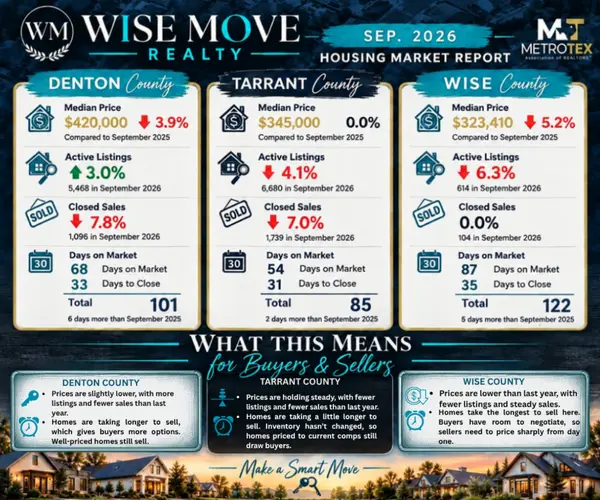
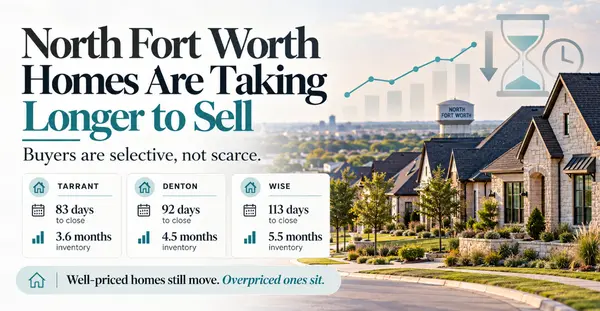
They're not the picture here. MetroTex's August report shows Tarrant County at 3.6 months of inventory, down from 3.9 a year ago, with active listings down 7.4%. Denton County sits at 4.5 months, nearly unchanged from last year. That's tighter supply than the statewide headline, not looser.
But the other half matters just as much. Closed sales in Tarrant fell 8.2%, and the median price slipped 2.9% to $340,000. Denton's median rose 1.2% to $440,000. Fewer sellers are listing, and fewer buyers are closing. Both sides of the table are pulling back at the same time.
Reality Check: Low inventory and a slipping median aren't a contradiction. That's what happens when rates price buyers out faster than sellers give up. Countywide medians also swing with the mix of what sold, so a month heavy on entry-level sales pulls the number down even when values hold. Your neighborhood's numbers in Keller, Haslet, or Northlake matter more than the county's.
What Does 7.28% Mean If You're Buying in Keller?
It means the same house costs you more every month. On a $600,000 loan, principal and interest at 7.28% runs about $4,105 a month. At last year's 6.34% average, it was about $3,730. That's roughly $375 a month for the same home, before taxes and insurance.
What it doesn't mean is that every seller in Keller or Roanoke is ready to drop price and pay your closing costs. Those concessions are real in markets drowning in supply. On the Fort Worth side, with inventory below last year, you'll find them on homes that have sat, not on the well-priced house that just hit the market.
The opportunity isn't the discount the headlines promise. It's time. Homes are taking longer to sell than a year ago, so you can actually walk the house twice, get your inspection, and negotiate repairs without competing against six offers.
Pro Tip: If you need a lower payment, ask about a seller-paid rate buydown instead of a price cut. A few thousand dollars toward your rate can lower your payment more than the same amount off the price, and a seller who won't move on price will often say yes to it.
What Does the Rate Hike Mean If You're Selling?
Your home's value didn't drop on September 16. Your buyer's budget did.
That's the shift sellers need to understand. Every quarter-point jump in rates removes some buyers from your price range entirely and pushes others to look at the next price band down. The house in Keller that would've drawn five showings last spring might draw three now. Same house. Smaller pool.
So the real risk isn't a falling market. It's overpricing into a thinner one. In Tarrant County, closed sales fell 8.2% in August, and homes took 83 days from listing to closing, four more than a year ago, according to MetroTex. Every extra week on the market is a week your buyer pool can shrink again.
What Most Sellers Miss: Price cuts don't recover lost time. A home priced right from the start in Haslet or Northlake will usually net more than one that chases the market down with two reductions. In a smaller buyer pool, your first two weeks matter more than ever.
What If You're Selling and Buying at the Same Time?
This is where people get stuck. If you've owned your home for 15 or 20 years and you're thinking about your next chapter, you're on both sides of this rate hike at once. And it hits each side differently.
As a seller, the hike works against you because it shrinks the pool of people who can afford your house. As a buyer, it may barely touch you. If you're carrying significant equity into the next purchase, you're financing far less, or nothing at all. A 7.28% rate on a small loan is a rounding error compared to the equity you're moving.
That changes the math on waiting. Holding out for lower rates mainly helps your buyer, not you. Meanwhile, the Fed's median projection shows one more hike this year and no cuts until 2028.
Local Note: The equity sitting in a long-held home in Keller or North Richland Hills often covers most or all of a smaller home in Roanoke, Justin, or one of the newer communities along the Alliance corridor. Run the numbers on what you'd actually finance before you let rate headlines make the decision for you.
What Should You Watch Before December?
The next two months will tell you more than any forecast. Here's what actually matters.
The Fed meets again in late October, and a second hike now looks unlikely. The economy added just 29,000 jobs in September, and markets cut the odds of an October hike to around one in five. December is a different story. Futures traders still see a hike there as likely.
The September inflation report lands October 14. If it runs hot, mortgage rates can move before the Fed does, the same way they climbed above 7% ahead of the September decision.
Then there's the season. TRERC expects inventory to pull back from its summer peak as fewer sellers list in the fall. Fewer listings with a thinner buyer pool tends to settle into a quieter, more balanced market through the holidays.
Pro Tip: Watch mortgage rates and the 10-year Treasury, not the Fed's announcements. Rates track the bond market, and they usually move first.
FAQs
How much did the Fed raise rates in September 2026?
The Federal Reserve raised its benchmark rate by 25 basis points on September 16, 2026, to a target range of 3.75% to 4.00%. It was the first increase since July 2023, and the vote was unanimous. The Fed's median projection calls for one more hike before the end of 2026.
What is the average 30-year mortgage rate in October 2026?
Freddie Mac's weekly survey put the 30-year fixed average at 7.28% as of October 1, 2026. That's the highest level since November 2023 and up from 6.34% a year earlier. Your actual rate depends on your credit, down payment, and loan type.
Are home prices falling in Tarrant County?
Slightly, by one measure. MetroTex reported Tarrant County's August 2026 median price at $340,000, down 2.9% from a year earlier, while Denton County's median rose 1.2% to $440,000. The Texas Real Estate Research Center's price index showed Fort Worth-Arlington values rising year over year through July, so the direction depends on the measure and the neighborhood.
Should Keller sellers offer to pay for a buyer's rate buydown?
It can be a smart move when buyers are stretched by rates above 7%. A seller-paid buydown often lowers a buyer's monthly payment more than an equal price reduction would. Whether it makes sense depends on how your home is priced and how long comparable homes in Keller are taking to sell.
Will mortgage rates go down by the end of 2026?
A drop by year-end looks unlikely. The Fed raised rates in September, markets still expect another hike in December, and the Fed's median projection doesn't show cuts until 2028. Mortgage rates follow the 10-year Treasury, so inflation reports can move them in either direction before the Fed acts.
The Bottom Line for Keller Buyers and Sellers
The Fed hike made borrowing more expensive. It didn't flip North Fort Worth into the buyer's market the statewide headlines describe. Buyers have more time and a little more room on price, but they're shopping fewer listings. Sellers aren't facing a glut, but they are facing fewer qualified buyers, so the price has to be right from day one.
Ready to talk through your next move? Schedule a conversation at WisemoveTX.com.
Joy Rhodes | REALTOR®
WisemoveTX.com
joy@wisemovetx.com
TX License #0622809
Categories
- All Blogs (65)
- Commercial / Investors (20)
- Equity & Investment Strategy (5)
- Family & Community (6)
- Food & Dining (3)
- Market Insights (25)
- Neighborhood Spotlights (11)
- North Fort Worth Growth & Development (6)
- North Texas Living (15)
- Outdoor Life & Recreation (4)
- Residential Buyers (27)
- Residential Sellers (24)
Recent Posts