Should You Sell Now or Wait? What Rising Inventory in North Fort Worth Actually Means for Your Timeline
Quick Answer: In North Fort Worth in 2026, waiting for a "better" market
is a bet that rates drop and buyer demand surges before more sellers enter
the market. That scenario helps you only if you're ahead of the competition
when it happens. Sellers who price correctly and list now have leverage.
Sellers who wait are likely to list into a more crowded field.
If I'm being honest, the "wait" instinct makes sense emotionally and doesn't hold up analytically.
Sellers who are waiting right now are waiting for something specific — usually rates coming down. The logic is: lower rates bring more buyers, more buyers mean more competition for my home, more competition means a better price. It's not wrong as a theory. The problem is the assumption buried inside it.
When rates drop, you won't be the only seller who decides it's time.
What the Numbers Actually Show Right Now
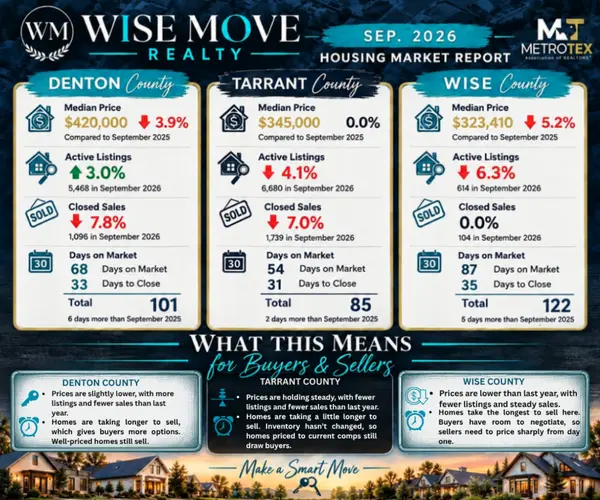
Tarrant County closed out November 2025 with prices down 5.2% to $336,450 and active listings up — while closed sales fell 10.7% year-over-year, per the Greater Fort Worth Association of Realtors. Active listings in the broader DFW market have surged roughly 40% compared to a year ago, per a March 2026 market analysis. That's not a collapse. That's a market with a surplus of product competing for a constrained buyer pool.
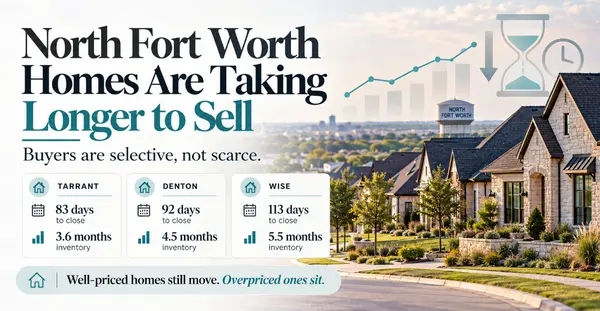
The Fort Worth market is currently sitting at approximately 4.2 months of supply with homes selling at 97.8% of the asking price — meaning buyers are negotiating but not hammering price, per Houzeo citing GFWAR data. (These are secondary sources; verify current figures through MetroTex/NTREIS for precision.) Homes are spending around 53 to 80 days on market depending on the corridor and price point.
That data tells a specific story: sellers who price correctly are closing. Sellers who don't are sitting — and accumulating days on market that make their next price reduction less effective than the first one would have been.
Reality Check: The market isn't broken. It's calibrated. The sellers struggling right now are struggling on price, not on the market itself.
What "Waiting" Actually Means in This Market
Waiting means one of two things is true when you eventually list.
The first scenario: rates stay elevated through the rest of 2026. Buyer demand remains constrained. More sellers who were also waiting decide to list at the same time you do, adding to an already elevated inventory pool. You list into more competition, not less.
The second scenario: rates drop meaningfully — say, toward 5.5% to 6%. Buyer demand does pick up. But here's what most sellers don't model: rate drops generate seller-side behavior too. Homeowners who've been locked in by their own low-rate mortgages start to move. Builders accelerate inventory to capitalize on the surge. The inventory that was absorbing slowly starts to move faster — but the new inventory that enters at the same time competes directly with yours.
In either case, the advantage of being first is real. The seller who lists in a less crowded field, at a price that reflects current data, moves before the competition recalibrates.
What Most Sellers Miss: The window where you're ahead of the next wave of competition is right now — not after the headline that tells everyone it's a good time to sell.
The Timeline You're Actually Working With
In the current DFW market, sellers should plan for a 3 to 5-month timeline from listing to closing when working with financed buyers, per a March 2026 DFW seller analysis. That includes days on market, contract period, and closing timeline.
For North Fort Worth sellers specifically — Keller, Haslet, Roanoke, and the corridors feeding the Alliance employment base — the buyer pool is active but selective. These buyers are often relocating professionals with real timelines. They're not browsing. They're comparing two or three well-priced homes and making a decision.
Being one of those two or three homes is a positioning question, not a timing question. And positioning is controlled by price and condition — not by waiting.
Local Note: Sellers in the Keller and Roanoke corridors who are priced within 3 to 4% of current comparable sales are moving. Sellers priced at 2022 comps are still on the market. The data is that clear.
What Pricing Correctly Actually Means in 2026
This is where the conversation usually gets uncomfortable.
The sellers who are waiting are often waiting because they have a number in mind — a number anchored to what their neighbor got in 2022, or what Zillow showed six months ago, or what they need to make the next purchase work. Those aren't market numbers. They're personal numbers. And the market doesn't negotiate with personal numbers.
Current Tarrant County data shows homes selling at approximately 97.8% of list. That's a disciplined market. It's not brutal — but it rewards sellers who price at market and punishes sellers who price above it with extended days on market and eventual price reductions that cost more credibility than the original reduction would have.
The seller who lists at market and closes in 45 days nets more than the seller who lists above market, sits for 90 days, reduces twice, and closes 10 weeks later at a number below where they should have started.
Pro Tip: Pull current closed comparable sales from the last 60 to 90 days — not the last 12 months. The market from 9 months ago isn't the market you're listing into today. Your pricing strategy needs to be built on what buyers are actually paying right now, not what sellers were getting when conditions were different.
FAQs
Is it a buyer's market or seller's market in North Fort Worth in 2026?
Tarrant County is sitting at roughly 4.2 months of supply — which puts it near balanced market territory, below the 6-month threshold that typically defines a full buyer's market. That means sellers aren't in a distressed position, but they're also not receiving multiple offers above list. It's a market that rewards correct pricing and penalizes overpricing.
Will waiting until rates drop make a difference for sellers in North Fort Worth?
Potentially — but only if you're ahead of the additional supply that a rate drop will trigger. Lower rates bring buyers off the sideline, but they also bring sellers. Homeowners currently locked into low-rate mortgages become more mobile when rates drop. Waiting for that moment means listing into more seller competition, not less.
How long should I expect my home to sit on the market before getting an offer in 2026?
In the North Fort Worth corridor — Keller, Haslet, Roanoke — homes priced at or just below current comparable closed sales are seeing offers in 30 to 60 days. Homes priced above market are sitting 80 to 120 days and beyond. The gap between those two outcomes is almost entirely a pricing question.
Should I make repairs before listing or sell as-is in this market?
Address core system issues — roof, HVAC, foundation condition, drainage — before you list. Buyers in 2026 are negotiating on inspections again, and unresolved system issues generate repair credits or price reductions that cost more than the repairs themselves. Cosmetic updates have a lower return threshold — prioritize condition and first impression over full renovation.
How do I know what my home is actually worth in this market?
Pull closed comparable sales from the last 60 to 90 days in your specific corridor. Not list prices — closed prices. That's what buyers are paying. Zillow and Redfin estimates are not authoritative for pricing strategy — they lag the market and carry significant error margins in smaller Texas markets. Work from NTREIS/Matrix data or ask an agent to pull a current CMA based on actual closed comps.
The Bottom Line
The question isn't whether to sell now or wait for a better market. The question is whether you understand what "better" actually requires and whether the math of waiting supports it.
In North Fort Worth in 2026, sellers who price at market, prepare their homes honestly, and list before the next wave of competition are positioned well. Sellers who are waiting for conditions to shift in their favor are betting on a scenario where they happen to be ahead of everyone else who's waiting for the same thing.
The sellers who close well in this market are the ones who stopped waiting and started positioning.
Ready to talk through your next move? Schedule a conversation at WisemoveTX.com.
Joy Rhodes | REALTOR® WisemoveTX.com joy@wisemovetx.com TX License #0622809
Categories
- All Blogs (65)
- Commercial / Investors (20)
- Equity & Investment Strategy (5)
- Family & Community (6)
- Food & Dining (3)
- Market Insights (25)
- Neighborhood Spotlights (11)
- North Fort Worth Growth & Development (6)
- North Texas Living (15)
- Outdoor Life & Recreation (4)
- Residential Buyers (27)
- Residential Sellers (24)
Recent Posts